

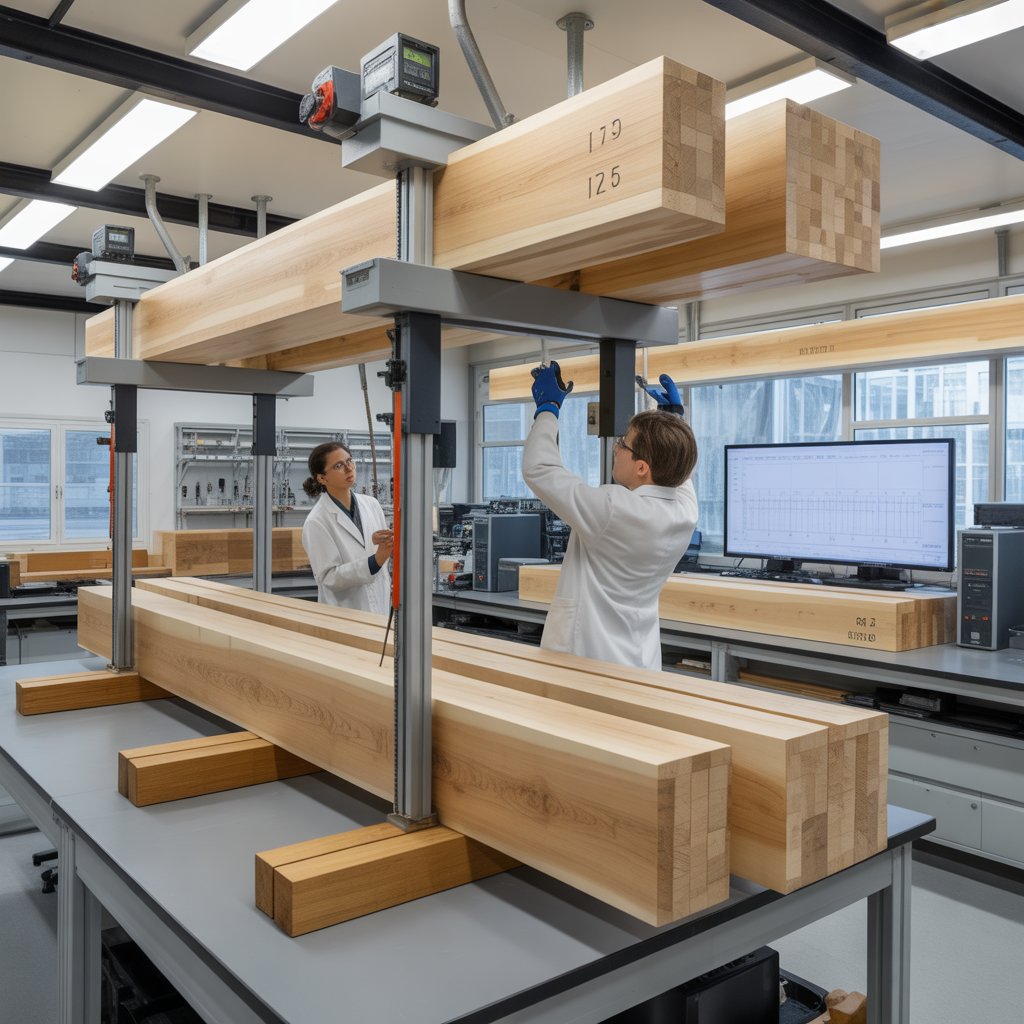
Global timber construction research is moving faster than ever. As universities, engineers and advanced manufacturers invest in new technologies, timber now competes directly with steel and concrete in strength, fire resistance and high-rise capability. Moreover, each breakthrough moves the world closer to carbon-positive construction. To highlight these changes, this article explores five of the most exciting recent developments that will shape the future of timber buildings.
1. High-Performance Mass Timber Hybrids
Mass timber already performs well, yet new studies show that combining engineered timber with steel or concrete dramatically increases structural efficiency. Instead of replacing traditional materials, researchers integrate them to create hybrid systems with optimal strength-to-weight ratios.
For example, advanced timber-steel composite floors now span longer distances with less vibration. Meanwhile, hybrid shear walls outperform previous models in seismic zones. Because of these improvements, architects can design taller, wider and safer timber buildings.
2. Bio-Based Fire Protection That Enhances Strength
Fire resistance remains a key research area. Excitingly, scientists are developing bio-based fire retardants made from plant-derived polymers. These natural coatings penetrate timber fibres and increase char predictability without harming structural strength.
Additionally, universities in Europe and Canada are testing lamella configurations that slow heat transfer while maintaining load-bearing capacity. As a result, mass timber assemblies now achieve fire performance ratings that satisfy even the strictest building codes.
3. AI-Driven Timber Grading and Predictive Structural Modelling
Traditional visual grading misses micro-defects that affect long-term performance. Fortunately, new timber construction research uses AI image recognition, machine-learning scanners and ultrasonic mapping to grade boards with microscopic accuracy.
Furthermore, digital twins and predictive structural models allow engineers to simulate moisture behaviour, creep, differential movement and load paths with exceptional precision. Consequently, designers can optimise material usage and reduce safety margins without risking performance.
4. Densified and Modified Timber Stronger Than Steel (by Weight)
Researchers in Japan, Finland and the United States have discovered methods to densify timber fibres, increasing compressive and tensile strength by up to 300%. After removing hemicellulose and compressing the cell structure, the resulting material becomes harder than many aluminium alloys by weight.
Even more impressively, modified timber displays reduced moisture sensitivity and improved dimensional stability. Therefore, it is ideal for connections, beams, hybrid slabs and other high-load components.
5. Carbon-Smart Timber Systems That Track Emissions in Real Time
Climate accountability is driving new innovation. Today’s research teams are building real-time carbon tracking systems that measure sequestration, emissions and end-of-life recovery for each timber element. As the construction industry moves toward net-zero regulations, these models allow developers to quantify environmental savings with scientific accuracy.
Consequently, carbon-smart design supports faster approvals, greener financing and stronger ESG compliance. For companies like Green Block, this aligns perfectly with our long-term sustainability vision.
Timber construction research continues to accelerate, and the results are remarkable. From high-performance hybrid systems to carbon-tracking digital models, each innovation strengthens the case for timber as the future of global building. As these technologies reach commercial scale, South Africa will gain safer, lighter and more sustainable structures — and Green Block is ready to lead the transition.
www.timberhome.co.za
www.timberhomeconstruction.co.za
www.timberhomeswesterncape.co.za
York Chair